
Chef Stage – What it is and How to Prepare

Doing a chef stage is one of those kitchen terms you might hear early in your career, but not everyone explains it clearly. In simple terms, a stage is a short period of time spent working in another professional kitchen to learn, gain experience, build contacts or, in some cases, be assessed for a role.
It can be exciting. It can also be intimidating. You are walking into someone else’s kitchen, with their pace, their systems, their standards and their team. The good news is that delivering a strong chef stage is not about pretending you know everything. It is about turning up prepared, listening properly, working cleanly and showing that you can be useful.
This guide explains what a chef stage involves, how to arrange one, what to bring, what happens on your first day, and how to make the most of the experience.
What does chef stage mean?
The term chef stage comes from the French word stagiaire, meaning trainee, apprentice or intern. In kitchen terms, a stage usually means spending time in another kitchen to learn new techniques, understand a different style of cooking and experience how another brigade works.
Is a chef stage the same as a trial shift?
A chef stage and a trial shift (or tasting interview) can overlap, but they are not always the same thing.
A stage is often about learning, exposure and experience. A chef might stage in a respected restaurant to understand a new cuisine, improve technique, see how a high-performing kitchen is run or build industry contacts.
A trial shift is usually more directly linked to a job opportunity. The kitchen is assessing whether you can do the job, fit the team and cope with the pace.
That said, some restaurants use the terms loosely. A chef stage interview may feel very similar to a trial shift, especially if the kitchen is hiring. Before you agree, ask what the stage involves, how long it will last, whether it is paid, what time you should arrive and what kit you need to bring.
Why a chef stage can be valuable
A good chef stage gives you something that no job advert or menu can show you properly: the feel of the kitchen.
You can see how the team communicates, how prep is organised, how sections and the pass are run, and how the senior team leads under pressure.
For chefs in the early stages of their career, it can help build confidence. For more experienced chefs, it can be a way to sharpen skills, explore a different restaurant style or test whether a new kitchen is somewhere you would want to work.
It’s also a chance to be seen. A strong attitude, tidy work and good awareness can stay in a head chef’s mind long after the shift finishes. And while not every stage is going to lead to a job offer, you can still walk out with new knowledge, a better network and a clearer idea of where you want to go next.
How to arrange a chef stage
A successful chef stage starts before you walk through the kitchen door.
Research the right kitchen first
Think about what you want from the experience. Are you trying to learn more about fine dining cuisine, improve pastry skills, work with a larger brigade, experience open-fire cooking, understand banqueting or step towards a specific role?
High-end restaurants often have more formal stage processes because they are used to chefs approaching them. Mid-level restaurants may be less used to stages, but they can still offer brilliant hands-on experience.
Look at the menu, the chef, the style of service, recent reviews and the type of team they appear to have in place. A stage should have a purpose. “I just want experience” is fine, but “I want to understand how your kitchen approaches whole-animal butchery, open fire cooking or tasting menu service” is stronger.
Make contact in the right way
A personal connection can help. That might be through another chef, a supplier, a former colleague, a friend in the industry, a direct message, an email or even by eating in the restaurant first.
Once you reach the right person, be direct and respectful. Explain who you are, your current experience level and why you want to stage there. Do not oversell yourself. If you are a commis chef, say you are a commis chef. If it’s your first stage, say it’s your first stage.
Kitchens respect honesty. They do not have much patience for someone who talks bigger than they can work.
Ask the important questions in one go
Chefs are busy. Try not to create a long chain of back-and-forth messages if you can avoid it.
Before you start, confirm:
- The date and arrival time.
- How long the stage is expected to last.
- Whether it is paid or unpaid.
- What uniform you should wear.
- What equipment you should bring.
- Who you should ask for when you arrive.
- Whether you need to bring any documents or proof of right to work if the stage is linked to a job.
Clear questions now mean fewer problems later.
What to bring to a chef stage
Turning up prepared says a lot about you, so it’s important to get some basics right.
Uniform and shoes
Unless told otherwise, arrive with clean chef whites or the kitchen’s requested uniform. Black chef trousers, a t-shirt and a white chef jacket as a standard starting point, with comfortable shoes that can be wiped clean. Bring a hair covering if needed.
Knives and basic kit
At minimum, bring the tools you would expect to use for basic prep. That might include:
- A sharp chef’s knife.
- A paring knife.
- A serrated knife.
- A steel.
- A vegetable peeler.
Make sure sure knives are sharp and practising basic knife skills before the stage if needed.
Notebook and pen
Bring a small notebook and pen.
You may need to remember station set-up, recipe notes, prep instructions, plating details or where things are stored. Nobody expects you to memorise a new kitchen in five minutes, but they will expect you to pay attention.
A notebook also stops you asking the same question again and again. That matters.
What to expect on your first day
Arrive early, but not awkwardly early. Five to ten minutes early in uniform is usually sensible. If you need to change when you arrive, allow more time.
Go to the correct entrance if you have been told where to go. In many restaurants, that may be the back door or kitchen entrance. Introduce yourself clearly and say you are scheduled to stage.
You may be passed to the head chef, a sous chef, a chef de partie or whoever is running the section you have been placed on. Do not expect a long welcome chat. This is a working kitchen. The person looking after you may already be thinking through a long prep list, service pressure and what tasks they can safely give you.
At first, you may be given something simple. That is normal. The kitchen is not insulting you. They are working out how you move, listen, ask questions and handle basic jobs.
Take the task seriously. The way you prep tomatoes, herbs, potatoes or garnish can tell a team a lot about how you work.
How to make a good impression during prep
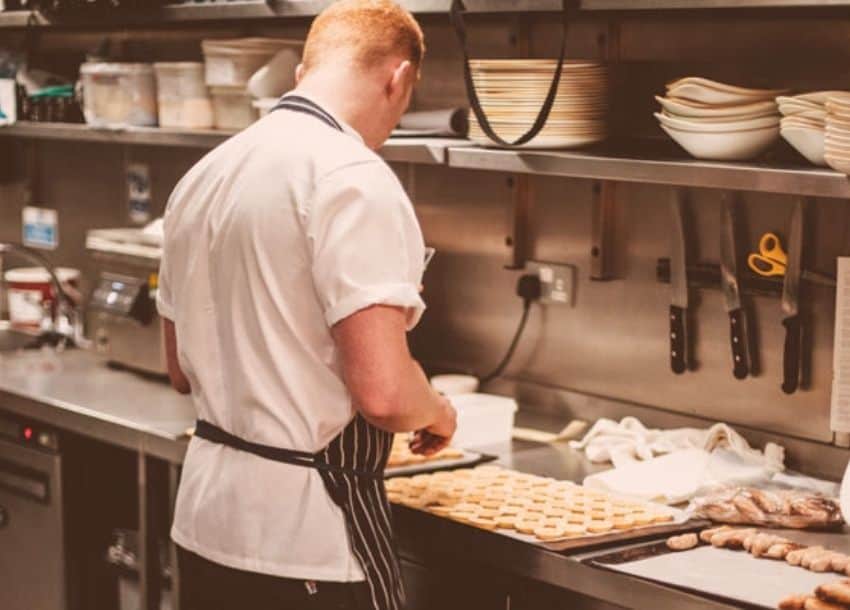
Prep is where many chefs on stage can be most useful.
Listen carefully when a task is explained. If you do not understand, ask. It is better to clarify than waste product, time and trust. Once you have been shown, try not to ask the same thing twice.
Work cleanly. Keep your board tidy. Wipe down properly. Label and store things the way the kitchen wants them done. Do not assume your normal way is better. You are there to learn their system.
Move with purpose, but do not rush into mistakes. A chef who works cleanly, asks sensible questions and improves through the day is far more useful than someone trying to look fast while making a mess.
What happens during service
Service is where your role may change.
In some kitchens, especially on day one, you may mostly watch. In others, you may be asked to fetch backups, restock mise en place, wipe plates, pass pans, dress a simple garnish or plate the same item repeatedly.
Whatever you are asked to do, do it properly. Stay aware of where you are standing. Do not block the pass. Do not wander into a section unless you have been asked. Do not ask big questions when the tickets are stacking up.
A chef stage kitchen can move quickly. You need to listen for calls, watch how people move and keep yourself out of the wrong place at the wrong time.
Use the right kitchen calls. Say “behind”, “hot behind”, “sharp behind”, “corner” and “oven open” when needed. These are not performance lines. They keep people safe.
Clean-down matters more than you think
The shift does not end when service slows down.
Clean-down is part of the job, and it is one of the best times to show that you are not just there for the exciting bits. Help break down mise en place, wrap and label properly, wipe surfaces, move pans and tools to the KP area, sweep, mop and reset where asked.
Do not disappear. Do not stand around waiting to be released. Ask how you can help.
Chef stage tips to remember
- Be honest about your experience level.
- Arrive prepared, clean and on time.
- Bring sharp knives and basic kit unless told otherwise.
- Take a notebook and use it properly.
- Ask questions when needed, but listen carefully to the answer.
- Do not ask the same question repeatedly.
- Learn names where you can.
- Use “yes chef” when appropriate.
- Accept feedback without arguing.
- Keep your phone away unless there is a genuine emergency.
- Wash your hands often and follow the kitchen’s hygiene rules.
- Respect the KP team and learn how they want things stacked.
- Stay aware during service and keep out of the way.
- Help with clean-down until you are told you can leave.
- Stay humble, positive and useful.
Common mistakes to avoid on a chef stage
The biggest mistake is pretending to be more experienced than you are. A professional kitchen will find out quickly. It is much better to be honest, keen and teachable.
Other common mistakes include arriving late, bringing blunt knives, standing in the wrong place during service, checking your phone, talking too much, asking questions at the wrong moment, ignoring hygiene rules or leaving before the section is properly cleaned down.
Another mistake is treating simple prep as beneath you. If you cannot do basic jobs cleanly and consistently, the team will not trust you with more complex tasks.
A chef stage is not about showing off. It is about showing how you work.
Final thoughts
A chef stage can teach you a lot in a short space of time.
You will see how another kitchen thinks, moves, communicates and solves problems. You may pick up new techniques, new standards and new ways of working. You may also learn what kind of kitchen you do or do not want to work in.
The best approach is simple: prepare properly, listen closely, work cleanly, stay humble and be useful from start to finish.
Whether your chef stage leads to a job, a contact or simply a better understanding of your craft, it is worth taking seriously. Every kitchen has something to teach you, and every stage you do can add valuable experience to your CV.
–
FAQs
What does chef stage mean?
A chef stage is a short period spent working in another professional kitchen to learn, gain experience or be assessed. The term comes from the French word stagiaire, meaning trainee, apprentice or intern.
How do you pronounce chef stage?
Stage is usually pronounced “stahj”, with a soft French-style sound. In kitchen conversation, you may hear people say “I’m doing a stahj” or “they are here on stage”.
Is a chef stage paid?
It depends on the kitchen and the situation. You should always clarify pay, hours and expectations before agreeing to a stage. If it is connected to a job, be clear on whether it is a trial shift, a paid shift or an unpaid stage.
What should I bring to a chef stage?
Bring clean uniform, safe kitchen shoes, sharp basic knives, a peeler, a notebook and a pen. If the kitchen has specific requirements, follow those first.
Can a chef stage lead to a job?
Yes, it can. A stage can help a kitchen see how you work, listen, move and fit into the team. It can also help you decide whether the kitchen is right for you.
How long does a chef stage last?
It varies. Some stages last a day or a few days, while others can run much longer, up to 3 months in some cases. Always confirm the length before you start.
What should I do after a chef stage?
Thank the chef or section lead before you leave, then follow up with a short message if appropriate. Keep it simple. Thank them for the opportunity, mention something useful you learned and say you would be happy to stay in touch.


Comments
Add a comment
Leave a Reply · Cancel reply
You must be logged in to post a comment.
